
CMG Buttery MB,BS. MPH. FACPM
( Curriculum Vita )
Introductory session
History, goals and organization of public health.
Students should be able to describe:
- How public health issues have affected health status over more than 4000 years.
- The purpose and outline methods used to develop public health policy and goals.
- The organization of federal, state and local health departments.
- Common activities carried out at each level, as well as certain special activities restricted to a particular organizational level.
- Who, what, when, why that make up the practice of public health
References
A History of Public Health. George Rosen and 'Future of Public Health'. IOM.
Reading
Introduction to Public health :Schneider 4th or 5th editions.. Chapters 1 through 3, also Chapters 5 & 7 for basic epidemiologic terms used in course, if you are not enrolled in an epi course...
Review difference between medical care and public health practice. Keep these differences in mind when you answer assignments and use the discussion board.
To read journals on-line use this library access web page
Special Reference. For students who have no experience with the US Health Care System a primer is provided here. Take your time over this. It can be completed over the course of the semester and will prepare you for classes on U.S. Health Policy.
The continuing theme of this course is that epidemiologic and biostatistical expertise are the underlying skills needed for all activities, whatever the field, in public health. Visit Healthy People 2010 and HP 2020 before each week's session and review that part of the Healthy People Process which relates to the week's discussion, to prepare your thoughts for the discussion boards. Also review this recent analysis of progress toward HP2020 goals
The first, and probably the only material you need to memorize from the entire course is:
- The Ten Essential Public Health Services (in the National Public Health Performance Standards Program)
these functions are the basis of public health as it enters the second millennium. They are the most recent consensus among the major national public health groups, following the 1998 "Future of Public Health" book (see link to the on-line text below), produced by the Institute of Medicine of the National Academy of Sciences. This book should be part of your own permanent library. You can also view the CDC PPT Slide Show of the 10 Essentials. This Ppt is worth downloading and keeping in your files to refer to throughout this course.
The triumph of public health.
Until recently, the concept of prevention was most often tied to public health efforts, in particular to the prevention of infectious diseases. These preventive interventions had their roots in the 1800s.
In 1846, Ignaz Semmelweis instituted hand washing on his obstetrical ward in Vienna’s teaching hospital, cutting the death rate among delivering mothers more than fivefold. Joseph Lister later credited his developments in antiseptic surgery to Semmelweis, “Without Semmelweis, my achievements would be nothing.”
In 1854, John Snow, Queen Victoria’s anesthesiologist, removed the handle from the Broad Street public water pump in London’s Soho district, ending a cholera epidemic that had killed more than 70 people over two days.
Most of the improvement in health in the USA over the last 200 years has been from environmental reduction of exposure to untreated sewage and untreated drinking water as well as population health programs directed at pregnant women and children and use of vaccines.
The ten essentials are the culmination of over 2000 years of development of 'Hygiene" practice as identified in the web page on the history of public health. Dr. Ted Tweel, past health director of Hanover County Health Department, has provided a short history of major events in Virginia's public health. Also review the History of Public Health in Virginia prepared by Jeff Lake, recently retired Deputy Commissioner of Health, VDH. An essential and REQUIRED reading about past history: Elizabeth Fee's Unfulfilled Promise (only 13 pages) will help answer the first discussion board question,.
Review the Consensus Statement on Quality in the Public Health System With particular emphasis in the short section on characteristics of quality in public health.
Take a look at death rates for the five leading cause of death in 1900 and see how they have changed, See the two graphics immediately below.. Also, look at the changes in life expectancy in the U.S. over the last 150 years
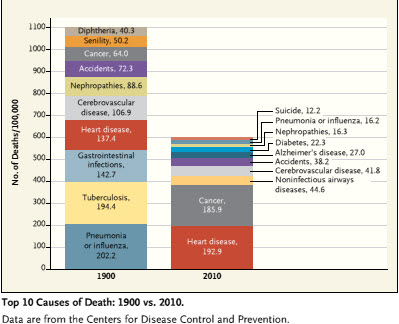

Statistics from the IOM
Vital Signs from the IOM, click on each button.
Look at the WHO Leadership Priorities(look at each big idea). How good is health care in the US, compared to other countries? Can you find the answer on the web and put your conclusion in the first section of the discussion board? Take a look at this introductory Chapter into the recent IOM study on international health disparities! particularly the first three pages, Also this recent article from JAMA on the US Burden of Disease. Scan the web page on national health initiatives get a feel for the breadth of public health interventions
An essential and REQUIRED reading about past history: Elizabeth Fee's Unfulfilled Promise (only 13 pages) which focuses on our failure to avoid repeating past bad decisions as demonstrated by this recent article in the NEJM.
For every lecture/discussion of the MPH program you should consider how the specific session incorporates the five basic skills of public health which are:
- epidemiology
- biostatistics
- environmental health
- social and behavioral science
- health services administration
Review the Principles of Public Health Ethics and consider whether they are also incorporated into the following extended skill set which the IOM 2003 study (scan chapter 4 on-line) recommended as being incorporated into all public health education:
- Informatics
- Genomics
- Communication
- Cultural competence
- Community based participatory research
- Global Health
- Policy and Law
- Ethics
Also look at the Core Competencies Project of the Council of Linkages. These core competencies are the application of the ten essentials (above.) While you are visiting this site look at the CCP home page to learn about the Council on Linkages. Each session will include a continuing focus on public health policy in practice. Policy development will be discussed in the Spring Health Policy course. The outline of Dr. Nelson's discussion of goals and policies in the public health arena are found in the Goals PPT show. Look at WHO 2015 Goals (pages 13 - 15), then look at the Healthy People 2020 topics. Then look at the HP2020 progress report. What do you think about the different progress between the two? The content of this paragraph helps answer the third discussion board question.
Also, in preparation for the remainder of the course review the content for training in public health AGAIN, recommended by the Teachers of Preventive Medicine. This outline was prepared as a supplement to the Ten Essential Functions, referred to above. This outline is pertinent to anyone planning to practice public health and should be used as a learning tool in every course you take. This will allow you to see how the various elements of each course fit into, and complement, other courses to ensure that you will develop the skills necessary to carry out the Ten Essentials. when you are awarded your MPH. Scan The National Prevention Council's "National Prevention Strategy"
There is a belief by many people that in United States that we actually have a health care system. In fact we have set of different activities each of which is a system of its own that added together make up the delivery of public health and health care in the United States. See the graphic in the paragraph below. After reviewing this slide you should understand that the Health Programs in the USA are not a "system": but a set of minisystems( federal, state, local, pubic & private) spread among many organizations with minimal coordination. To help you understand this complexity in the U.S. is basic to the changes in public health and personal health care that is occurring at present, by looking at this set of articles from JAMA. The first looks at health outcomes in the United States compared with other countries. Then the article from JAMA on the so-called health system in the United States, followed by discussion of critical issues and values and then the article on linking individual health care and health of populations and the role of population health which is what this introductory course is about. Then look at this progress on seven current objectives from the CDC which focus on population health. This material should help answer the second discussion board question.
As one way of displaying the major elements of health care provided in the U.S that I developed in this graphic. If you want to print out this graphic use landscape mode. [When you mouse-over this image the pointer will change to a hand indicating a linked popup box. Click on the area and read the text. Be sure to close the popup before trying to access the next one.] If you have any problem with the text boxes you can see the information in the US Health System pdf. Also scan this viewpoint of the US health Care system from a recent article in JAMA., Also scan at this article by Dr. Friedman, director of the CDC, in The New England Journal,
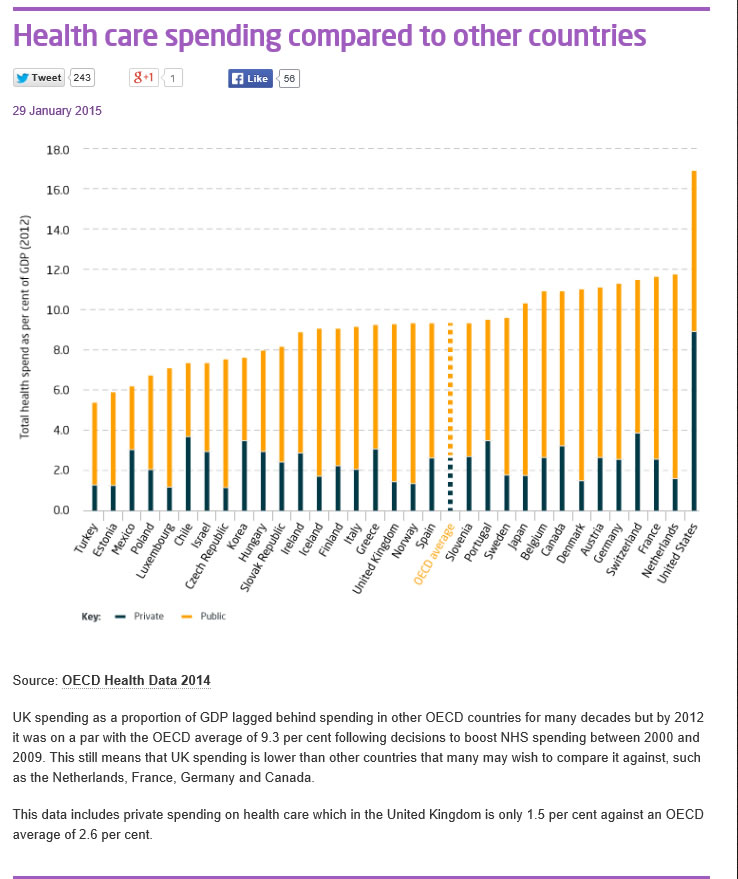
The WHO Statistical Report of HEALTH SYSTEMS Performance for 2003 (see page 13) indicated that the US was 37th when measured by health outcomes such as death rates, disability rates, and survival rates. Also review the report, issued in August 2006, from the Commonwealth Fund about development of a "High Performance Health System" in the US. If you want to follow this up I will be happy to forward the complete report (some 18 pages) by e-mail upon request, and the update in 2010Update, Also the update of the CF review of the US vs. Other countries health care competence. Also look at this latest update from the OECD of per capita spending by country.
Finally see the report of the last decade of worldwide achievements of Public Health, and the new Challenges of Prevention.
Take a look at the following article as we will be coming back to them in nearly every session in one form or another: definition of Health. Also this recent "think piece' from JAMA. I have introduced a new module on Chronic Diseases which has become a leading issue for pubic health in the last 5-10 years, worldwide.
Valuable URLS:
WHO A guide to statistical information at WHO
WHO Statistics Reports
The next two documents may be scanned for this session, but read through during the rest of the course as the contents will place many of the other issues into perspective in the rapidly changing field of pubic health policy, particularly the segments on primary care access and caring for he uninsured
Obstacles to changing the system. Scan Only
Bookmarks To start building your own reference files
Also, You may want to place the following in your Links for public health on your web browser as you start to develop a pubic health library.
National Academies Webcasts.
Key Resources on Health Coverage and the Uninsured
JHU Pod Med weekly broadcasts.
Additional Useful Readings to add to your public health library:
Does the US have the best HC System in the world? (Short Video) While you watch Dr. Lundberg's short talk ask yourself how many of the criteria for care that he recommends, do you and your classmates meet? Take a poll!
Closing the Digital Divide
How to read an article
National Academy Press
The Public's opinion about Public Health